
Fuel Catalysts
Benefits & Evidence
PART 1 of this page summarises the case that use of fuel catalysts results in:
But nothing is foolproof, and PART 2 of this page explains the (not many) circumstances in which fuel catalysts will not make a noticeable difference and / or will not be worthwhile to fit.
Part 1. Summary of fuel catalyst benefits and evidence.
1. Extra power, reduced toxic exhaust emissions, and improved fuel efficiency in general have all been demonstrated in formal laboratory tests of fuel catalysts.
Decades of laboratory tests of fuel catalysts under controlled conditions have produced very substantial evidence to show improved fuel efficiency with associated consumer and public health benefits. And many of these tests are listed in the Fuelspiracy! special report that is available as a free download. Examples include:
Many more formal tests and results such as these are referenced in the Fuelspiracy! special report that is available as a free download.
And Fuelspiracy! also shows exactly how and exactly why knowledge of these tests and results has been prevented from reaching the awareness of the wider public.
Extensive laboratory tests such as the above have been reinforced with vast numbers of field reports such as these.
Decades of laboratory tests of fuel catalysts under controlled conditions have produced very substantial evidence to show improved fuel efficiency with associated consumer and public health benefits. And many of these tests are listed in the Fuelspiracy! special report that is available as a free download. Examples include:
Rather like a bigger engine has been fitted.
“Hi Andrew, last year in 2025 I fitted fuel catalysts you supplied into my 2016 Kia Picanto 1.25ltre petrol, 5 speed manual, with the mileage just topped forty thousand. Before fitting the catalysts I lowered a flexible nylon tube down the petrol filler pipe to feel for any obstructions. There were none so I inserted the catalysts then reinserted the tube to ensure they arrived at the tank, they did. Started the Car and drove around the block and parked. The following day driving the car noticed a very significant improvement in performance, rather like a bigger engine has been fitted!. On a dual Carriageway near here a long incline, the car flies up this hill overtaking vehicles that it has no right to do at all, it now loves hill climbing, All this without foot to the floor, just a little throttle is all that is required, I love this car. OK now mpg was about average 44.5 pre catalyst, now never drops below 50 even at motorway speeds. About me, I am not a young tearaway, I am 81, but I don’t drive like a elderly person, I drive with purpose, concentrating on my driving and I don’t talk while driving!”
DAVID CASSELL, Havant, Hampshire
At £8 per gallon for fuel I saved £192 on fuel cost alone on this single 4,300 mile trip.
“Hi Andrew, just a few notes about my experiences with the fuel catalysts you supplied and which last year I fitted in my 2003 Mercedes Sprinter 311 CDI that I have owned since 2014. It has to be said that the van has always driven pretty well, but since the catalysts it has seemed distinctly better still. And this is especially when it comes to fuel economy which I have always measured as carefully as I can, and prior to the catalysts I never managed more than 25 MPG at best however carefully I drove. But I have recently returned from a 4,300 mile three month trip around Europe with the catalysts fitted taking in France, Italy and returning through the Balkans, and the MPG was a consistent 29MPG a difference of 4 MPG achieved on less than optimal non motorway/mountain roads for approx 30+% of the trip. If my fuel calculations are correct, and I’m pretty confident that they are, it means that at £8 per gallon for fuel I saved £192 on fuel cost alone on this single 4,300 mile trip, and this is not to mention cuts in emissions etc. In conclusion I would recommend this product as the returns are much greater than the comparatively minimal once-only investment of under £90 for my 3.85 ton vehicle with 209,000 miles covered.”
Shane Gilpin, Paignton, Devon
2. The ability of fuel catalysts to allow engines designed for expensive high quality fuels to use inexpensive low quality fuels instead.
The Fuelspiracy! special report shows how fuel catalysts were first used by the Royal Air Force during World War II in order to enable Hurricane aircraft, that normally required very highquality fuel, to operate successfully on very low quality fuel.
Fuelspiracy! also documents use of fuel catalysts decades later to enable engines that needed high octane leaded petrol to run on standard low octane unleaded petrol. This included vehicles operated by police forces, ambulance services, local authorities and other large fleets. Fuel catalysts were outstandingly successful in this regard (as with many other things) with users routinely reporting significant improvements in performance and fuel economy on low quality unleaded petrol with fuel catalysts than had previously been the case with high quality leaded petrol without fuel catalysts.
Similarly, fuel catalysts are nowadays allowing engines designed for expensive 99-octane E5 petrol to operate successfully on much less expensive supermarket E10 petrol**. They are also being used with diesel engines designed for expensive premium quality fuel in order to allow them to run successfully on standard supermarket fuel.
Examples of reports of 99 Octane E5 performance from 95 Octane E10 petrol:
”I fitted the catalyst straight away into the tank of my Royal Alloy scooter. The main reason for fitting it is the phasing out of E5 petrol in favour of E10. My scooter is supposed to run exclusively on E5 so being able to run on E10 as a result of fitting the catalyst without performance loss was my goal. I’m happy to report since my gradual switch to the E10 fuel exclusively with the catalyst there has been NO loss of performance or fuel mileage in fact the acceleration now appears smoother and I am getting approximately a 20 mile increase on mileage per tank of fuel”.
MARTIN MOUNTFORD, Stoke-0n-Trent
“Our car is a CLK200 Mercedes Benz that says unleaded E10 fuel on the fuel cap but it ran better on the more expensive E5 leaded fuel so I continued with E5 until I came across a podcast with Andrew as guest and ordered a few, tested them and the car now runs as if it’s running on E5 and it seems to have more power and the fuel lasts longer!!!”
RYAN KROSS Zwolle, The Netherlands
Fuel catalysts in a Mazda 2. “Initially, I put two in… it was very easy to do and I wished I’d got on with fitting them sooner as it started saving me money immediately because I then transitioned from using more expensive 99 Octane E5 petrol to 95 Octane E10 petrol. My car ran as smoothly as it had done before the fitting. I’ve now purchased a Mazda 3, and recently bought some more catalysts, so I can again benefit from using the cheaper E10 fuel without any negative effects”.
RUTH BARRINGTON, Bath
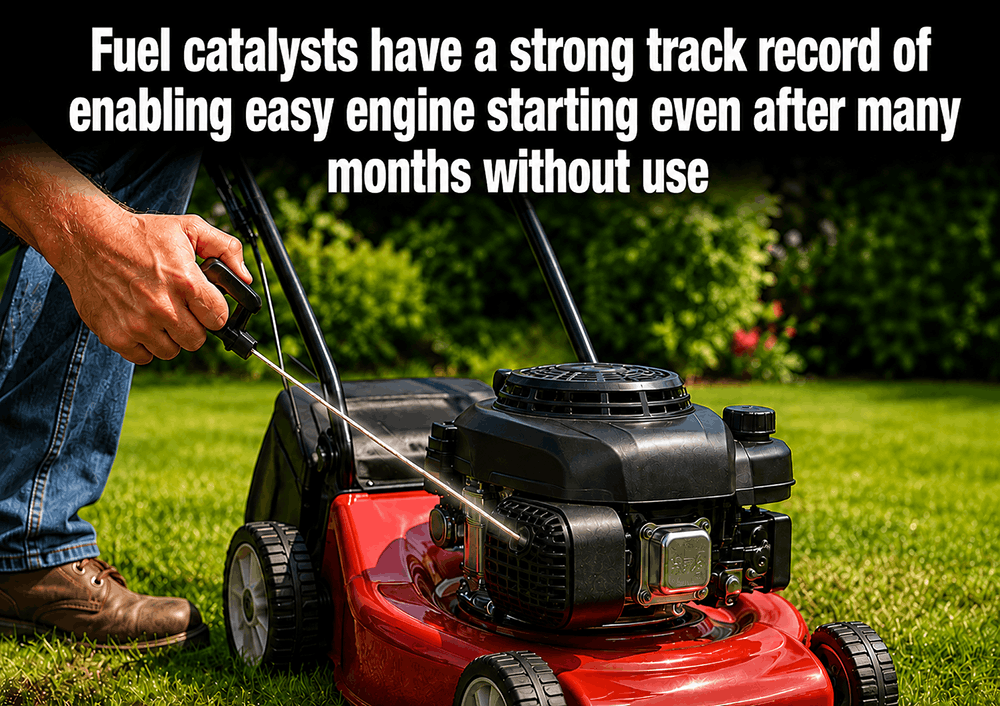
3. There are even cases where fuel catalysts enable engines to start first time when otherwise they’ll not start at all.
From the moment fuel leaves the refinery its quality begins to decline primarily because of oxidation and moisture. This often become catastrophic when the like of marine outboards, lawnmowers, motorcycles, generators, and other seasonally used engines are left unused for months at a time. This is because fuel forms into acids, gums, and varnish-like deposits that in turn restrict fuel flow, interfere with carburettors and injectors, and in severe cases contribute to an engine becoming difficult or impossible to start. However, by modifying fuel chemistry as they do, fuel catalysts address these problems with users finding that engines which had previously been difficult to start after long periods of inactivity were able to start easily with fuel catalysts fitted in fuel tanks.
Extra power, easy starting, ‘gunk-free’ carburettors, and improved engine performance.
JACK DAWSON, Double D Motorcycles, Plymouth, commenting on fuel catalyst experiences in conjunction with modern fuels.
This was using the original fuel catalyst product called Carbonflo that, to all intents and purposes, was the same as modern versions available from this website, except that the modern versions feature enhancements to achieve at least the same, and often even better, outcomes.
“I own Double D Motorcycles in Plymouth and have been in the trade as a mechanic since 2001. I first heard about Carbonflo 2 years ago when I fitted it in all the bikes I own including a Yamaha BWS125, a Yamaha FS1E50, a Honda 900 Fireblade, a Honda CF70 and a Suzuki Bandit 1200 not to mention a petrol strimmer and a chainsaw and a generator and other machinery. Before fitting Carbonflo, when the machines were not used for periods of time, fuel in the tank would degrade and cause clogged carburettors and sometimes fouled injection systems which would often make starting hard or impossible, and rough running when they would start. Since fitting Carbonflo however there have been no signs of any such problems. In particular I had left my Honda Monkey bike unused for 18 months but with Carbonflo in the tank it fired up 3rd time and ran well even after all that time.
Furthermore there have been no signs whatsoever of issues such as gums or waxes affecting any of the machines and I have also found subtle but noticeable improvements in power and performance. Therefore I have also sold many Carbonflo units to friends and customers and they have had similarly positive things to say”.

IMPORTANT POINTS WITH SMALL ENGINES!
- Fuel catalysts have been found to preserve and improve fuel quality ever since the RAF used them during World War Two
- With the vast majority of small engines fitting is perfectly simple (just drop into the tank)
- Fuel catalysts for small engines up to 250cc are £14.95, or up to 800cc £29.90, and to all intents and purposes they last forever!! (Prices include VAT, but exclude delivery)
Many more tests and results are referenced in the Fuelspiracy! special report that is available as a free download from the Fuelspiracy! section.
Part 2. Where fuel catalysts will not make a noticeable difference and / or will not be worthwhile to fit.
The benefits of fuel catalysts become blindingly obvious in innumerable cases. This even includes (as above) where they allow engines to start first time when otherwise they would not start at all.
But nothing is foolproof and:
- There are cases where it takes time for improvements to become obvious
- There are cases where fuel catalysts will work but the gains, although valuable, will not become easily noticeable
- And there are also cases (not many) where fuel catalysts will not make a difference and / or will not be worthwhile to fit.
1. Cases where it takes time for improvements to become obvious.
Power and performance improvements are in many cases immediately obvious, in many other cases they take time
Simple before / after dynamometer tests have regularly shown power increases within an hour of fitting in the order of 2% to 4% and sometimes more, indicating that as soon as fuel is treated by fuel catalysts it burns more thoroughly and efficiently. This power increase may not be noticeable to all drivers, although it is to many. But the more thorough fuel combustion removes carbon build up from within engines and once this has happened (usually after 1,000 or 2,000 miles) improvements in performance have become noticeable to the large majority of drivers.
Noticeable improvements take longer to materialise with larger engines
The above applies to all engines. But, with larger engines such as HGVs, instead of improvements becoming noticeable to the large majority of drivers in 1,000 or 2,000 miles it is more often as much as 5,000 miles.
Emissions may rise temporarily before falling to permanently lower levels
Emissions from engines with heavy carbon deposits may initially increase after fuel catalysts are fitted. And when this happens it is because of removal of carbon deposits in the engine that then exit the engine via the exhaust system (hence the best time to fit fuel catalysts may not be immediately prior to an MOT test). Once carbon deposits have been removed however, toxic emissions including HC, CO, particulates, black smoke and NOx have all been shown to be reduced by use of fuel catalysts. This not only results in cleaner air but also reduced problems with the like of DPF filters as well as reduced AdBlue consumption in diesels, together with reduced risk of MOT emissions test failures.
2. Where fuel catalysts will work but the gains, although valuable, will likely not become obviously noticeable.
Engines that are already powerful
Power increases that result from fitting fuel catalysts are typically in the order of 2% to 4% initially, with these increasing over time. And whilst these gains are sufficient to be noticeable with vehicles that are under-powered, with vehicles that are already very powerful they are less likely to be noticeable. Even so, such engines will nevertheless stand to gain from use of fuel catalysts in terms of fuel economy, less problems with DPF filters and less AdBlue needed in diesels, engines designed for expensive high quality fuels enabled to use inexpensive low quality fuels instead, and so on.
3. Where fuel catalysts won’t make a difference and / or will not be worthwhile to fit.
Incorrect fitting
It cannot be over-emphasised that correct fitting is essential both for safety and for results. In particular fuel catalysts must be immersed in fuel in the fuel tank for them to work. In machinery from almost all outboard marine engines, motor cycles, garden equipment and many others, fitting is simply a case of dropping the catalysts into the fuel tan in order to be certain that the catalysts are in the tank and do not get lodged in the filler pipe where they will not work. And whilst it is the same with many cars there are others in which professional assistance with fitting will be necessary. For fitting information please see FITTING FUEL CATALYSTS
Already fitted
Although uncommon, it has happened that a used vehicle has been purchased that, unbeknown to its new owner, has already had catalysts fitted by a previous owner, and in these cases extra catalysts may make little extra improvement.
Fuel catalysts reduce wear and tear of engine and exhaust system components. However they cannot fix existing mechanical or electrical faults, or prevent unrelated mechanical or electrical faults from occurring.